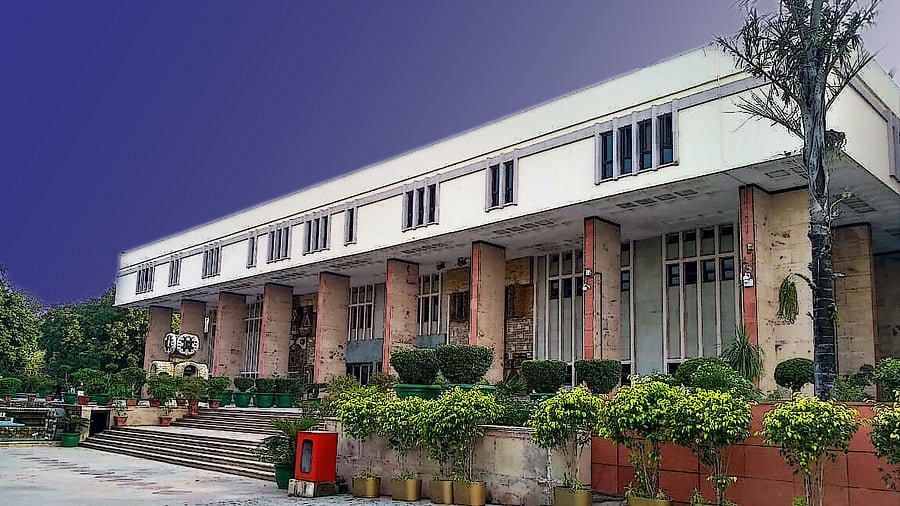
The Delhi High Court quashed an FIR against a competitive exam aspirant, ruling that mere presence at a protest beyond permitted hours does not constitute an offence absent active participation in unlawful acts.
Mere Presence at Protest Not Criminal, Says Delhi High Court
In a significant ruling for the protection of fundamental rights, the Delhi High Court quashed an FIR against a competitive examination aspirant who was present at the Ramlila Maidan during demonstrations related to Staff Selection Commission (SSC) exam irregularities. Justice Sanjeev Narula, in Khurshid Ahmed v. State of NCT of Delhi, held that mere presence at a protest venue beyond stipulated hours cannot, by itself, constitute a penal offence without evidence of active participation in unlawful or violent conduct.
The petitioner, Khurshid Ahmed, was booked under Sections 188 (disobedience to order promulgated by public servant), 143 (unlawful assembly), and 149 (unlawful assembly, every member of which is guilty of an offence) of the Indian Penal Code, following protests at Ramlila Maidan concerning alleged irregularities in SSC examinations. Police contended that the gathering persisted past the time allowed for demonstration. However, the petitioner argued that he was peacefully protesting and did not commit any violent or disruptive acts.
The act of being present at a protest site beyond permitted hours, without more, does not ipso facto render a person criminally liable,
the Court emphasized, noting that criminal liability must be predicated on active involvement in unlawful acts, not passive attendance. The Court reiterated that the right to peaceful assembly, guaranteed under Article 19(1)(a) and (b) of the Constitution, cannot be curtailed solely on grounds of timing unless public order is demonstrably threatened. Given the absence of allegations of violence or incitement, the FIR was deemed an unjustified infringement on constitutional freedoms.
The ruling reinforces the legal distinction between presence and participation in unlawful assemblies. For practitioners, this decision underscores that charges under Sections 143 and 149 IPC require evidence of shared unlawful purpose, not just physical presence. Law enforcement must exercise caution in invoking penal provisions against demonstrators absent concrete evidence of misconduct. The judgment is likely to influence bail and charge-framing decisions in protest-related cases.
Citations
- Khurshid Ahmed v. State of NCT of Delhi (2026)

